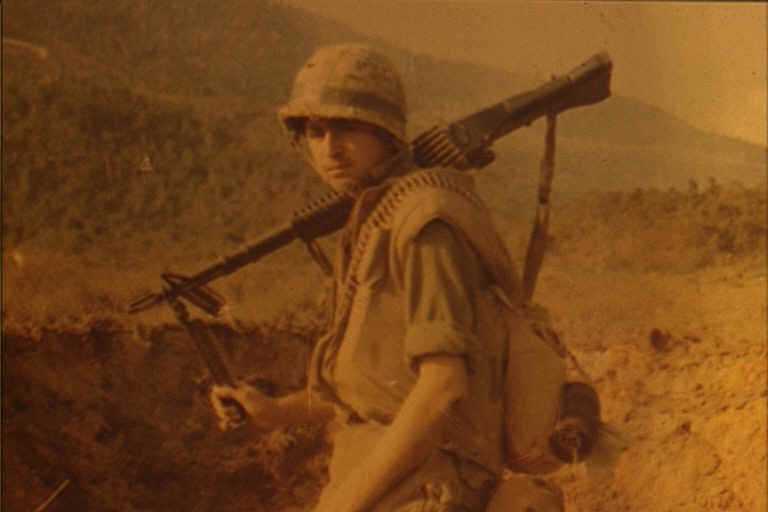
For those who have fought for it, life has a flavor the protected will never know"
So goes the introduction to Refugio "Cook" Barela 's diary of his days in Vietnam. It is an overture befitting a man who has had to fight for nearly every inch of progress gained in his life. A Los Angeles Police officer by day and pastor of the Sunnyslope Community Church during evenings and Sundays .Barela 39, in the past year also found time to lead civic protest to the Garb Oil and Milliken waste-to-energy incinerators. The Citizens Awareness Committee, founded by Barela, has lobbied for a signal light at the intersection of Valley Way and 34th Street in addition to opposing the incinerator plants.
But most Jurupa residents know Barela as the president during the past year of the Jurupa Unified School District Board of Education. During his term he fought for and partially attained assistant principals for each school in the district, implemented " one of the mostsuccessful drug programs in the state," and got plans rolling to provide a cafeteria/assembly room for schools without them.
He also accepted leadership of a civic commitee trying to bring a Veterans Home to Jurupa that would provide jobs and boost the local economy.
Recently Barela graduated from the first Masters of Boardmanship class of the California School Board Association - one of six persons in the state to do so. As a delegate representative for imperial and Riverside Counties on the CSBA, he has lobbied Governor Duke Deukmejian on behalf of hundreds of school districts.
Barela is the kind of man who feels "Like I belong" in the Sacramento statehouse while at the same time, in his day-to-day job, can sincerely term L.A.'s Skid Row as "the most fun area to work in."
"Expect a Miracle" says a wall-to-wall inscription behind the pastor's podium at the Sunnyslope Community Church. With a glance at Barel's history, it is easy to see why this slogan has meaning to him and his flock.
While children today occasionally find a cardboard box to make a playhouse out of, Barela spent his early years in a house composed partly of cardboard.
Behind the cardboard front door of his boyhood home were 13 children. Four were from his father Felix' first marriage (the first wife died). At age37, Felix married Barela's mother concha when she was 17 years old and sired nine more children.
Barela is number seven in the lineup.
Refujio Medina Barela came by his nickname "Cook" from his older brother who adapted the Spanish nickname CuCo to "Cookie" and later just "Cook"
Barela was born Nov,11 at his fathers's farm in Las Cruses, New Mexico, where his family raised vegetables for sale in the nearby markets. A short time later, the farm failed and the family moved to the city dump in Casa Grande, Ariz., where the senior Barela made a living selling scrap metals for recycling.
When Cook was four years old, his father was killed by a drunk driver on his way back from a day of selling metal in Phoenix. To this day , Barela finds satisfaction in removing drunk drivers from the streets of L.A.
Barela helped support his family until he was 17 years old, and then he moved to Southern California, For a year he picked fruit and vegetables.
He was occasionally reminded of his older brother in the Army who had looked so sharp in his uniform, "that I hoped there would be a war when I grew up so I could have a uniform like his."
Barela got his chance as Vietnam escalated into full-scale war. In 1966 Barela joined the Marines, where he would serve until 1970.
"I chose the Marines because they are the best trained branch of the service and I figured the best training would give me a better chance of getting out alive," Barela says, That was before Barela was placed as the M-60 rifleman in a platoon - before he realized that " a jar-head carrying an M-60 had an average life expectancy of two seconds after the first shot was fired in a fight."
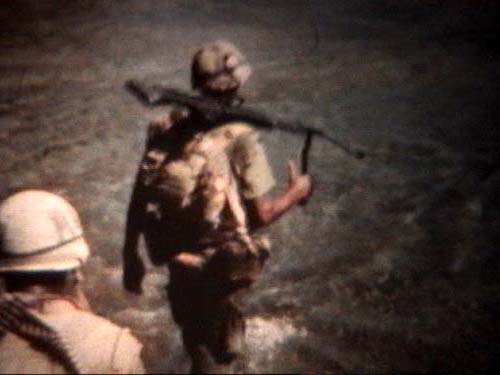
Thirteen months later, everyone else in Barela's platoon had been either killed or wounded. In one ambush, he recalls, only 12 men from a platoon of 49 came out alive. In another situation, he woke up at 1 a.m. looking up the barrel of an enemy rifle in the dark.
"I should have beeb killed nine times that I know of," Barela says, He credits two people with saving his life. One time his platoon was saved from certain ambush by cautious company commander Charles Robb, son-in-law of President Lyndon Johnson."
In the other case, his "Bro" Ron Moore, from Manhattan Beach, took his place as machine-gunner on a dawn patrol outside Da Nang and never came back. "He had been there longeer than me and he always told me 'Never volunteer for anything.'" But on that particular morning, Moore gave his jacket to the sleeping Barela, picked up Barela's M-60 and later walked into an ambush from which only one Marine survived.
 Like many veterans from the war, Barela returned to the states somewhat disoriented and discouraged. Hungry and deserate for work, his first job stateside was going door-to-door selling encyclopedias. After his first day, Barela returned to the office empty handed and with doubts about his future. The sales manager wrote a quote on the blackboard and told him to memorize it: "On the plains of hesitation lie the bones of countless millions who, at the dawn of victory, laid down to rest, and resting, died."
Barela went out the next day and sold his first set of encyclopedias. "I knew then that I would never starve," he chuckles.
Like many veterans from the war, Barela returned to the states somewhat disoriented and discouraged. Hungry and deserate for work, his first job stateside was going door-to-door selling encyclopedias. After his first day, Barela returned to the office empty handed and with doubts about his future. The sales manager wrote a quote on the blackboard and told him to memorize it: "On the plains of hesitation lie the bones of countless millions who, at the dawn of victory, laid down to rest, and resting, died."
Barela went out the next day and sold his first set of encyclopedias. "I knew then that I would never starve," he chuckles.
For the next six months Barela sold encyclopedias until signing up as a reserve deputy with the Fresno Sheriff Department. He decided he liked law enforcement and involved himself in accident investigation, eventually joining the Central Traffic Division of the Los Angeles Police Department.
Barela said he had religious awakening in 1976 at the time his brother was dying of cancer. Barela had been raised a Catholic but had occasional exposure to his sister's Pentecostal church -- "She used to let me use her car during the week if I went to church on Sunday."
Barela says ge had a series of dreams that stirred a fervent faith in Christianity.
JURUPA DECISION MAKER3rd in a Series
Three years and some dozens of rallies, lectures and articles later, Barela was ordained a minister at the Fair Havens Missionary Outreach in Montebello. Barela now serves as the only licensed and ordained minister among four chaplains now serving the Los Angeles Police Department. Chief Daryl Gates appointed Barela to the special duty post in June 1985 and recently renewed his two year term.
Fellow officers call Barela and his partner (a former Jew converted to Christianity by Barela) the "God Squad" and they refer to Barela as the "Cop who walks with God down Wilshire Boulevard."
As chaplain, Barela is charged with meeting the religious and spiritual needs of police officers and their families, be they Jewish, Protestant, Catholic, Muslim or Agnostic. "I have to be informed and knowledgeable to be of any help to such a diverse group," says Barela.
He spends much of his time as chaplain counseling troubled people, but more often he performs funerals for fellow officers or their families.
In spite of the atmosphere of sadness in which he often works, Barela finds chaplain work rewarding. "I enjoy the opportunity to minister to people ... seeing their burdens lift."
"Police officers are by far the most unchurched while at the same time being among the most spiritually needy," Barela observes from his ministry. He adds, "Rarely do I find an unbeliever when I start talking to another officer...I guess it's part of the macho cop image that they don't ackowledge their needs and voids."
Everyone has spiritual questions like "Who am I, where did I come from and why am I here?" contends Barela. But among people in the LAPD, the spiritual void is compounded by the feeling that "you're just a number."
Making people accept the personal, caring part of their job is one of Barela's priorities as a member of the school board. The attitude of caring about other people is essential, Barela maintains, in making a difference with youths in the school district who are struggling with drug related problems.
"In every case, you have to acknowledge the person is human before you can help him change. Sometimes just having someone recognize their existence is enough for a kid to change," he says.
Barela's work as a chaplain and lecturer has come in handy at the Sunnyslope Community Church where he has recently accepted the position of interim pastor. He will continue to serve there until a fulltime pastor can be secured.
Amid the heavy demands on his time is Barela's top priority -- time with his wife of 10 years, Marylu, and their five daughters: Rebekah 9, Serah 7, Deborah 6, Joannah 4, and Elizabeth 2. He also has two sons from a previous marrige, Troy 20 and Jeromy 15.
Daughter Rebekah provided the inspiration for Barela to seek office on the school board. Her poor classroom performance after the family's move to Jurupa concerned Barela, and as he worked to help her improve, he began to see things he wanted to change in the school district. When his campaign began, he had a list of 49 changes he wanted to make -- 20 of which have been done r are being done, says Barela.
Topping his list for the next year is mastery of the legislative issues which will have an impact on the Jurupa School District. It's a complex job, he says, to grasp some 70 spending billspending in the state legislature, each of which would change income in th elocal district.
He is also concerned wi the "vulture system" (sic) of student placement which encourages districts to rob other districts of students in their attendance area in order to gain the supplemental state income.
Barela supports cityhood for Jurupa but his personal political ambitions go higher. If he can master the legislative issues, he says, he hopes to run for state or federal office after his retirement from the LAPD after another three years. That way he could combine his analytical skills, his capacity to find compromise and his desire to help people to produce "the utmost positive effect for everyone."
At the same time he is improving education for others, Barela has been working to enhance his own education. While in the Marine Corps, Barela obtained a G.E.D. equivalent to a high school degree, and later attended Cerritos College and East Los Angeles Junior College. He holds lifetime teacher's credentials for driver's education and administration of justice.
This Spring, Barela intends to enroll at RCC to complete requirements for a degree in administration of justice. Barela says he may switch to political science later.
A student of the school of hard knocks, Barela says whatever success he attains is due to making the most of every opportunity and sharing his bounty with others.
"Soon you'll find that you are always at the right place at the right time," he says.
Somehow Barela finds time for a few hobbies -- golf, photography and writing. His photography is mostly color but occasionally he has taken black and white prints which were subsequently purchased by the Associated Press. Barela is an avid writer, having published several articles on terrorism and religion.
Today Cook Barela is the senior pastor of FACES (Familes Associated in Christian Evangelistic Services, a Christian Family Ministry. He obtained his master's Degree from Fuller Theological Seminary. And publishes, Inside The Heartland Magazine, a conservative, family values magazine.