Vietnam vet is ready to accept his medal
Published: July 28, 1999
Edition: RIVERSIDE; DESERT & PASS; HEMET-SAN JACINTO; TEMECULA-MURRIETA; SOUTHWEST; CORONA-NORCO; MORENO VALLEY
The Press-Enterprise Section: LOCAL
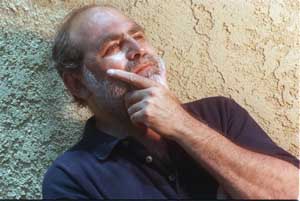
Art: PHOTO Caption: Kurt Miller / The Press-Enterprise
By David E. Hendrix |
A.J. "Cook" Barela watched the red water swirl among the rice plants and nudge the dike wall. He knew he was seeing the blood of fellow Marines mix with water irrigating the Vietnam rice paddy.
In that instant, Barela decided he didn't deserve the Purple Heart medal waiting for him in a battlefield ceremony.
Barela certainly had been wounded in combat by the enemy, a prerequisite for the medal. As the 19-year-old sat at the dike's edge, shrapnel was embedded in his legs. The temporary paralysis caused by the explosion of a hand grenade at his feet had worn off only hours before.
"When I saw the blood still flowing in the muddy rice paddies where we had fought the day before, I felt . . . those Marines had paid a higher price," Barela said.
That was Nov. 22, 1967, after three days of fierce battles with North Vietnamese regulars who had cut his platoon from 47 men to 12. Almost 32 years after turning down his medal, the Jurupa resident is scheduled to receive the award Saturday from a Marine unit based at March Air Reserve Base.
The event is about more than joining a fraternity that traces its roots to the Revolutionary War, Barela says. Requesting the medal has helped him validate his past, understand why he spent 30 years in self-imposed silence about his Vietnam experiences, and reach out to other men whose emotions have made them silent casualties of the war and its aftermath.
"The young warriors who came home were pinned down for 30 years in the rice paddies of American shame," Barela said. "Now, when you're in your 50s, you're thinking, `What great things have I done?'
"Most people believe that war is full of pain and suffering, and it is," said Barela, a minister who organizes home churches in the Inland area. "But war also gives birth to a lot of love and friendship and camaraderie and honor." Soldiers who fought with Barela in Vietnam echo his sentiments and say they are thrilled for him. They credit him with having saved many comrades and applaud him for helping others heal their emotions and spirits.
It was retirement from the Los Angeles Police Department, on July 4, 1992, that led Barela face-to-face with his past and guided him to his future. He already was a community activist, had been a Jurupa Unified School District board member and eventually ran for Congress, unsuccessfully.
"After I retired I decided to read books and began reading books on Vietnam," he said, sitting in his office. Every wall is jammed with shelves crammed with books. Most of the volumes are about the Bible, living a Christian life or counseling.
A small section, however, is related to military history and issues. Some large military maps show the "Liberty Bridge" area southwest of Da Nang where Barela and other Marines, mostly teen-agers, became combat veterans in the 1st Platoon, India Company, 3rd Battalion, 7th Marines.
It was Nov. 21, 1967 -- three days before Thanksgiving -- that North Vietnamese regulars attacked the company in the three-hut Phu Phong 2 hamlet near the Song Thu Bon River.
Barela operated an M-60 machine gun. Dennis Martinez, now a Burbank contractor, was a member of Barela's machine gun squad and a close friend. Half of the hamlet's circle faced a thick tree line behind a dike and the other half faced a rice paddy, Martinez remembers. The platoon had just finished lunch and was preparing to leave.
"I walked to the outside of the perimeter, maybe 20 to 30 feet from the hootch (hut) and then fire breaks out," Martinez said in an interview, speaking of the engagement as if it were this morning. The foliage was so thick that although he was only 4 feet away, the North Vietnamese seemed invisible. "You couldn't see them; you could only see puffs of smoke in the trees," he said.
"Everything that was truly brutal took place in the first 30 seconds. Everybody went down. And I can't tell you why the hell I made it. There were guys laying everywhere. It's not quite what you see in the movies. The first thing you're trying to do is get down and stay alive and communication is nonexistent. You're on your own. A guy could be 5 feet away from you and you couldn't tell he was there."
Barela, caught in the open, moved away from where most of the platoon had taken cover.
"The enemy was taken by surprise when I opened up with the machine gun from out in an open area but I knew my weapon and knew that was the only way we would be able to gain fire superiority," Barela said in a May 5 letter to Marine Corps Commandant Gen. Charles Krulak.
Darrel Keller, a Navy medic attached to the Marine company, now lives in Grand Prairie, Texas. If the men didn't call him Doc, they called him Pop, because at 22, he was older than those he cared for.
He had searched for Barela for years and only made contact early this month through a mutual friend.
The firefight remains vivid in Keller's memory.
"Barela and his platoon got chopped up real bad," Keller said. "He even advanced beyond the line of security and he was with his machine gun giving covering fire. I had to work hard to keep from falling apart. That night there were 18 to 20 of those in his platoon that got hit."
The firefight, much of it during pounding rain, lasted about four hours. During one assault, the North Vietnamese broke through and lobbed a hand grenade at Barela's position.
Barela didn't recognize the object as a grenade, he said. He thought it was a can of dirt and wondered why enemy troops were throwing cans of dirt. "As it (grenade) rolled toward our position, I turned to engage the enemy soldier rushing toward us from our left. It was then that the grenade exploded under me and the concussion picked me up and threw me backward about 15 feet." Barela could not move and had no feeling below his waist. He began crawling and was assisted by a corpsman -- not Keller -- who moved Barela to safety and pinned a yellow tag to him so he could be evacuated by helicopter.
But enemy fire was so heavy, helicopters had to wait. Finally, the North Vietnamese withdrew. Barela still couldn't move.
"At the end of the day, me and Michael (Jones) took Cook and we made a bed, and it was still raining, and it was full of mud," Martinez recalls. "Vietnamese have shallow, 6-foot-long baskets, about 4 inches deep, for winnowing rice and rice hulls. We found two of those and pushed one down in the mud and he (Jones) laid down on the bottom and we put Cook in the middle and me on top and I put the other basket on top. And we spent the night that way."
The next morning, Barela's legs strengthened and he began walking, waiting for a helicopter ride to a hospital. The yellow tag affixed to him was a ticket out of the battle zone. Many of his buddies, with various wounds, were with him.
As they waited, a colonel arrived to recognize those tagged by medics. The honorees would receive Purple Hearts. As others prepared the impromptu ceremony, Barela sat down by the rice paddy to wait.
That's when he saw the red water and knew whose blood colored it. He felt they had "paid a higher price." He quickly speaks their names as he tells the story.
"I took the yellow tag that was still attached to my flak jacket and buried it right there in the mud of the rice paddy field," Barela said.
He told his lieutenant he wasn't going to take the medal.
He also declined his helicopter ride out.
"My legs were still numb and weak, but that would mean the platoon would have had only one machine gunner so I chose to stay out in the field," Barela said. Martinez said he is not surprised Barela sidestepped the Purple Heart. "I can see Cookie doing it. There was blood there. At this point of the day, there's still chaos going on, there's still patrols going out. It was an unbelievable moment."
Keller, the medic, said Barela's decision might be understood only by those who have endured such circumstances.
"We had a higher regard for that Purple Heart," Keller said. "I had guys hanging on to me and my flak jacket, and they were crying for their families back home and all I could do is stabilize them and try to keep them alive to fly them back home.
"I don't understand why I got home. He (Barela) deserves it."
Barela saw more combat, finished his tour, finished his enlistment and thought he was finished with the Vietnam War. Like many veterans, he didn't talk about his experiences.
"When we went there, the war was still popular," he said. "When we came home, it wasn't. So we just didn't talk about it." Keller remembers.
"When we flew over the Golden Gate Bridge (on return), there wasn't a dry eye on the plane," Keller said. "Then we landed at San Francisco Airport. And there were police holding off people who were screaming and calling us names. Here I had just left half my company killed in Vietnam, and here were these people trying to hurt us. I stuffed it for years."
Barela became a Los Angeles policeman, working for 21 years as a traffic and intelligence officer. He also began reading the Bible, earned a master's degree in Christian leadership from Fuller Theological Seminary and became a police chaplain, counseling officers and their families about personal problems.
When his post-retirement reading tugged him back to Vietnam, he remembered a daily diary he had kept. He found the journal, stained with water from rain and rice paddies, read it and felt compelled to write a book. When finished, he read the last chapter to his wife and then cried for an hour as the cork popped from bottled emotions.
That's when he began hunting for his former comrades who survived the battle at Phu Phong 2 hamlet. He organized a reunion in February 1997, where a dozen middle-aged men hugged, laughed, cried and shared memories. Self-imposed silence about wartime experiences seemed to be a universal bond. Barela said the reunion authenticated experiences, some that he thought he had dreamed.
Martinez had a similar reaction.
"Most of these 30 years I was convinced I was hallucinating, that I had made them all up," Martinez said. "At the reunion, I found out a lot of things that I thought I was dreaming, I wasn't."
Barela now has an Internet site to reach out to other veterans who may live in silence and to inform people about what it was like to survive in Vietnam. The interactive site (http://www.insidetheweb.com/mbs.cgi/mb572821) has maps and photos. Some days it receives more than 250 visits.
Barela adds a new page daily from his diary.
At the 1997 reunion, his ex-platoon members found out he had walked away from the Purple Heart and urged him to apply for it. His sentiments had changed. He wrote the Marine Corps and on June 17 he was notified his medal had been approved.
"Receiving it (medal) is symbolic of the fact that it's time to get up out of the rice paddies and be honored," Barela said. "We served with honor and integrity. At the time, it was because of the ones who were wounded and killed that I didn't want it. Now, it's because of them that I want it -- to honor them."
Martinez, who also received a Purple Heart, said he is proud of Barela's efforts.
"Seeing him get it is almost like my getting mine back," he said.
"He was like all of us, no big hero," Martinez said. "You have to see a person's insecure side to know them. You see the fear in their eyes. There were days we would fight about taking the gun. `You take the (machine) gun,' one would say. `No, I'm not going to take the gun, you take the gun,' the other would say.
"Most people are not heroic all the time. But that's what makes them special." Published 7/28/1999
Contact the metro/news staff.
Page#: B01
CORRECTION: A STORY IN WEDNESDAY'S NEWSPAPER ABOUT A JURUPA MAN TO BE AWARDED THE PURPLE HEART MEDAL GAVE THE WRONG INITIALS FOR THE VETERAN. HIS NAME IS R.M. "COOK" BARELA. [7/29 RDHSCM]
The Press-Enterprise
More than 30 years after declining a Purple Heart for his Vietnam service, A.J. "Cook" Barela has decided to accept the medal. "Receiving it is symbolic of the fact that it's time to get up out of the rice paddies and be honored," he said.
2.Dennis Martinez, right, wanted to swap weapons and hold Barela's M-60 for a picture from Vietnam. In return, Barela got to write Martinez's sister.
Copyright The Press-Enterprise Co.
Follow-up story